

Two projects from the Upper Pyrenees and Aran awarded grants for early detection of deep vein thrombosis and subcutaneous fat assessment
This is the third edition of the IRBLleida Biomedical Research Projects, Alto Pirineo and Arán Category call for proposals, funded by the Lleida Provincial Council and promoted by the Department of Health
A project to study the early detection of deep vein thrombosis in primary care in Pallars Sobirà and another on a pilot study to perform subcutaneous abdominal, visceral and steatosis ultrasound scans were the winners of the third edition of the Biomedical Research Projects competition, Alto Pirineo y Arán category of the Lleida Biomedical Research Institute (IRBLleida), funded by the Lleida Provincial Council and promoted by the Department of Health. Today, 1 December, the two grants were awarded at a ceremony in Tremp.
The aim of this grant is to introduce professionals from the Alto Pirineo y Arán Health Region to the field of research at the Lleida Biomedical Research Institute (IRBLleida) in order to promote biomedical research that reaches and adapts to the idiosyncrasies of the territory. The grants, which will last for one year, are worth €5,000 each.
The first award-winning project aims to improve the early detection of deep vein thrombosis in primary care in Pallars Sobirà by implementing a clinical detection protocol and studying its feasibility in the area. 'The use of a specific protocol for the early detection of deep vein thrombosis will improve the identification and appropriate referral of patients with clinical suspicion,' explained researcher Daria Mazzuoli.
The second project receiving funding aims to validate a pilot study using ultrasound to analyse subcutaneous fat in a population at the Tremp Primary Care Centre. "Obesity is one of the leading causes of global morbidity and mortality due to its association with diabetes, dyslipidaemia and hypertension. Abdominal ultrasound is accessible, safe and, with standardised protocols, reliable for measuring abdominal thickness," explained researcher Pau Surribas.
In this second edition of the awards, the results of the two projects from the second edition were also presented. The ESMOLET (Sport, Health, Medicine, Opportunity, Learning, Transversal) study will enable the incorporation of prevention and safety elements to minimise the number and severity of accidents in outdoor leisure activities. The second project awarded a grant last year analysed knowledge and attitudes related to conscientious objection and other types of objections to requests for euthanasia.
At the scholarship award ceremony held today in Tremp, the manager of the Alto Pirineo y Arán Health Region, Felip Benavent, expressed his satisfaction with the third edition of these awards, which 'are an incentive for professionals and highlight projects that have a real impact on the health of the population.' Benavent also welcomed the fact that the grants 'demonstrate the sensitivity of both IRBLleida and the Provincial Council to the region, as well as the Department of Health's commitment to improving access to research away from the large Catalan hospitals.'
For his part, the director of IRBLleida, Diego Arango, highlighted 'the willingness and motivation of professionals in the Pyrenees to carry out biomedical research in areas of interest to the population of the region.'
Finally, the regional delegate of the Government to the Upper Pyrenees and Aran, Sílvia Romero, stressed the importance of bringing research closer to the region with initiatives such as that of IRBLleida, with the support of the University of Lleida, the Provincial Council of Lleida and the Health Region. The delegate noted that 'research helps to attract and retain healthcare professionals in the Pyrenees and that local projects allow us to work with data tailored to the needs of the region.'
In this regard, Sílvia Romero pointed out that research complements teaching, emphasising the new UdL-Pirineos campus and the degree in Nursing, and that 'the awards obtained demonstrate that it is possible to carry out quality research in the Upper Pyrenees and Aran, making the healthcare profession more attractive'.
This commitment to research by the Alto Pirineo y Arán Health Region is reflected in its 2021-2025 Health Plan, which sees research as a lever for change in the health system and includes a specific focus on research and innovation aimed at addressing the needs of the health system. Furthermore, in Catalonia, research and innovation are part of the Strategic Plan for Health Research and Innovation (PERIS), in which research and innovation are seen as drivers of transformation that provide solutions to people's health problems through the integration and generation of knowledge.
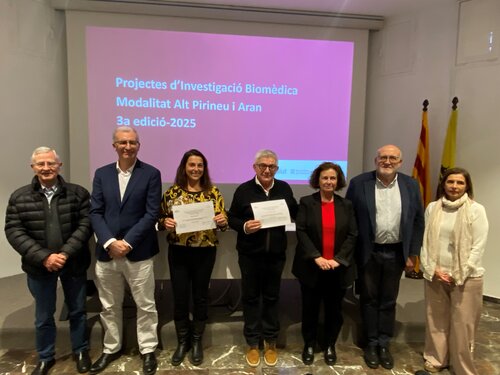
The award winners at a ceremony held in Tremp

